Note: This chapter includes discussion of protest, discrimination, racism, and threats of violence. These topics are included to help understand how people in Kirklees responded to injustice and worked for social change. Teachers may wish to introduce this section carefully and allow time for discussion or questions.
Formed in 1974 from 11 diverse towns and boroughs, Kirklees was more than an administrative creation, it brought together communities with distinct histories, cultures, and voices.
From its earliest days, the borough became a site of political engagement and social activism, where local people took a stand on issues from civil rights and racial equality to peace, nuclear disarmament, and humanitarian aid.
Across Huddersfield, Dewsbury, and beyond, grassroots movements and community organisations have shaped Kirklees into a place where civic action is both a tradition and a defining feature of its identity.
Pride
On 4 July 1981, Huddersfield hosted the UK’s first Pride parade outside London. The march was held to support the Gemini Club, a popular gay club in the town, which had been repeatedly targeted by police raids. The owner of the club, John Addy, faced the threat of losing his license, and local people wanted to show their support. Around 2,000 people joined the parade, marching through Huddersfield despite threats of violence from members of the National Front, a far-right political group known for promoting racist and anti-immigrant views.
At the rally in Greenhead Park, Jackie Forster, who co-founded the lesbian group Sappho in 1972, gave a speech to encourage and inspire the crowd. John Addy led the parade, driving his pink Rolls Royce surrounded by activists. The demonstration was successful, and the Gemini Club kept its license and stayed open for several years. Although the club eventually closed in the 1980s as Manchester and Leeds became bigger centres for the gay community, the Huddersfield Pride of 1981 remains an important moment in the history of LGBT+ activism in the UK.
National front
In the 1970s, Dewsbury became a focus for National Front activity due to its high Asian immigrant population, many of whom had settled in Savile Town from Gujarat and Pakistan to work in the shoddy industry, a trade that recycled old woollen cloth into new fabric. The National Front held public marches and rallies to gain support, prompting counter-demonstrations by anti-fascists. These events were often documented by West Yorkshire Police, who used the footage both to identify participants and to refine policing tactics.
The 1970s also saw a rise in racist attacks, particularly targeting South Asian communities. While much of this went unreported, it reflected deeper racial tensions in the area. Some local people blamed these problems, such as unemployment and housing shortages, on immigration, even though the real causes were economic and social pressures affecting everyone in the community.
Nuclear Disarmament
In January 1981, Kirklees Metropolitan Council became a Nuclear Free Zone, joining a growing movement of over 150 local authorities in the UK. The Council passed a motion asking the government not to make or place nuclear weapons within Kirklees and to ensure that no nuclear waste would be dumped or transported through the area.
To help the public understand more about nuclear weapons and their effects, the Council promised to provide information on the questions of war and peace. In May 1983, they set up a War and Peace Sub-Committee to continue this work.
Kirklees was considered a potential target in a nuclear war because of its many industrial and chemical works, some of which had military contracts. The Council encouraged people to think for themselves about the effects of nuclear weapons on their families, communities, and town. They were advised to discuss these issues with friends, neighbours, and community groups, and to write to local councillors, Members of Parliament, or the Secretary of State for Defence if they wanted their voices to be heard.
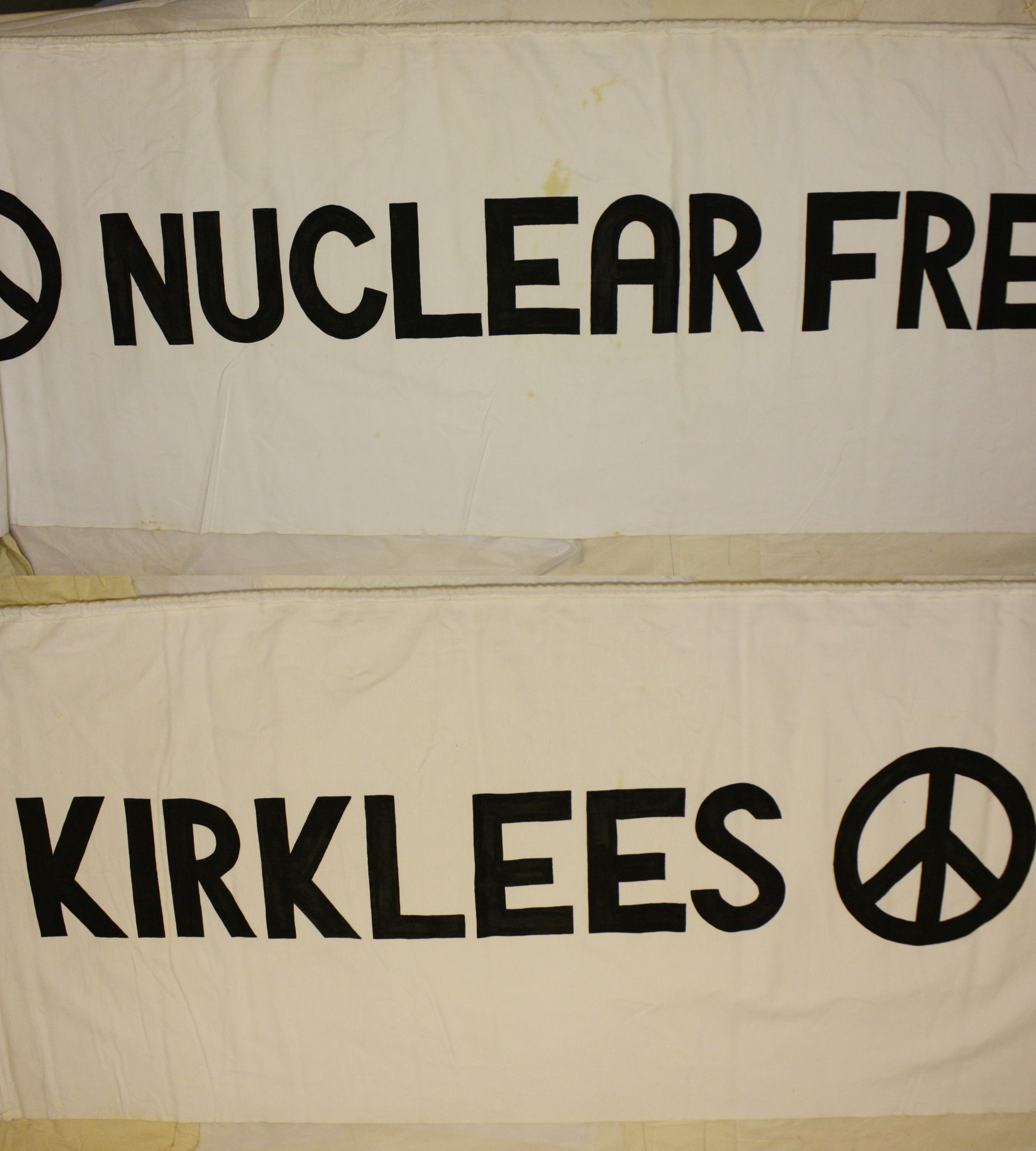
A booklet was produced to explain the impact of nuclear weapons specifically in Kirklees, helping people make informed choices about war, peace, and their own role in protecting the community.
The Kirklees Nuclear Free Zone shows that local councils and communities were taking action on national and global issues, like nuclear weapons and peace. People were encouraged to discuss these topics, get involved, and make their voices heard, reflecting a society that valued civic responsibility. It also shows the impact of Cold War fears, as towns with industry were seen as potential targets, shaping everyday life and attitudes.
HudFfam
During the Second World War, Huddersfield saw the creation of the Huddersfield Famine Relief Committee, later known as HudFam, in response to famines in India and Greece. Founded in 1943 by Elizabeth Wilson, a Quaker, humanitarian activist, and Oxfam volunteer, HudFam worked to raise funds for relief efforts both locally and overseas. The organisation became a sister branch of Oxfam and opened a shop in the town, one of the first charity shops in the country, selling second-hand clothes and fair-trade products.
Harold Wilson
Harold Wilson is one of the most famous people to have been born in Kirklees, serving as British Prime Minister between 1964 – 70, and 1974-76. He was born in Cowlersley, Huddersfield, on 11 March 1916. His father, Herbert, was a chemist who became involved in politics, and his mother, Ethel, had been a schoolteacher. Harold was a bright student and won a scholarship to Royds Hall Grammar School in Huddersfield before going on to study at Oxford University.
During the Second World War, Wilson worked in the civil service as an economist, helping the government plan how to use resources. After the war, in 1945, he became a Member of Parliament and quickly rose through the ranks of the Labour Party. By 1963, he was chosen as the party’s leader, and in 1964 he became Prime Minister, the youngest for more than 50 years (he was 48 years old).
As Prime Minister, Wilson introduced important reforms that shaped modern Britain. Under his leadership, laws were passed to make society fairer, such as the abolition of the death penalty for murder (though it technically remained for crimes such as treason), the decriminalisation of homosexuality in private, and greater rights for women. He also made huge changes to education, creating new universities and polytechnics to give more young people the chance to study.